The Design of Comfort in Animal Farming
The facilities where livestock is bred and grown are usually hidden in today’s agro-industrial landscapes, and yet the rise of intensive animal farming practices during the last century should not come as a surprise. One of the first books that investigated and reported on the ghastly conditions of intensively reared livestock was Animal Machines, published by British activist and author Ruth Harrison in 1964.6 However radical in her position, Harrison was not interested in eliminating animal farming altogether. The book was a manifesto against the regime of cruelty on the industrial farms and it meant to increase awareness on the health risks towards humans posed by unsanitary environments and massive use of antibiotics. The publication of Animal Machines was a turning point for the European zootechnical industry, as it paved the way for the Brambell report in the UK (1965) and the subsequent legislative framework on the conditions of farmed animals. Thanks to that report, the idea of animal welfare was quickly “established as a term, a concept and a target of government regulation.” 7
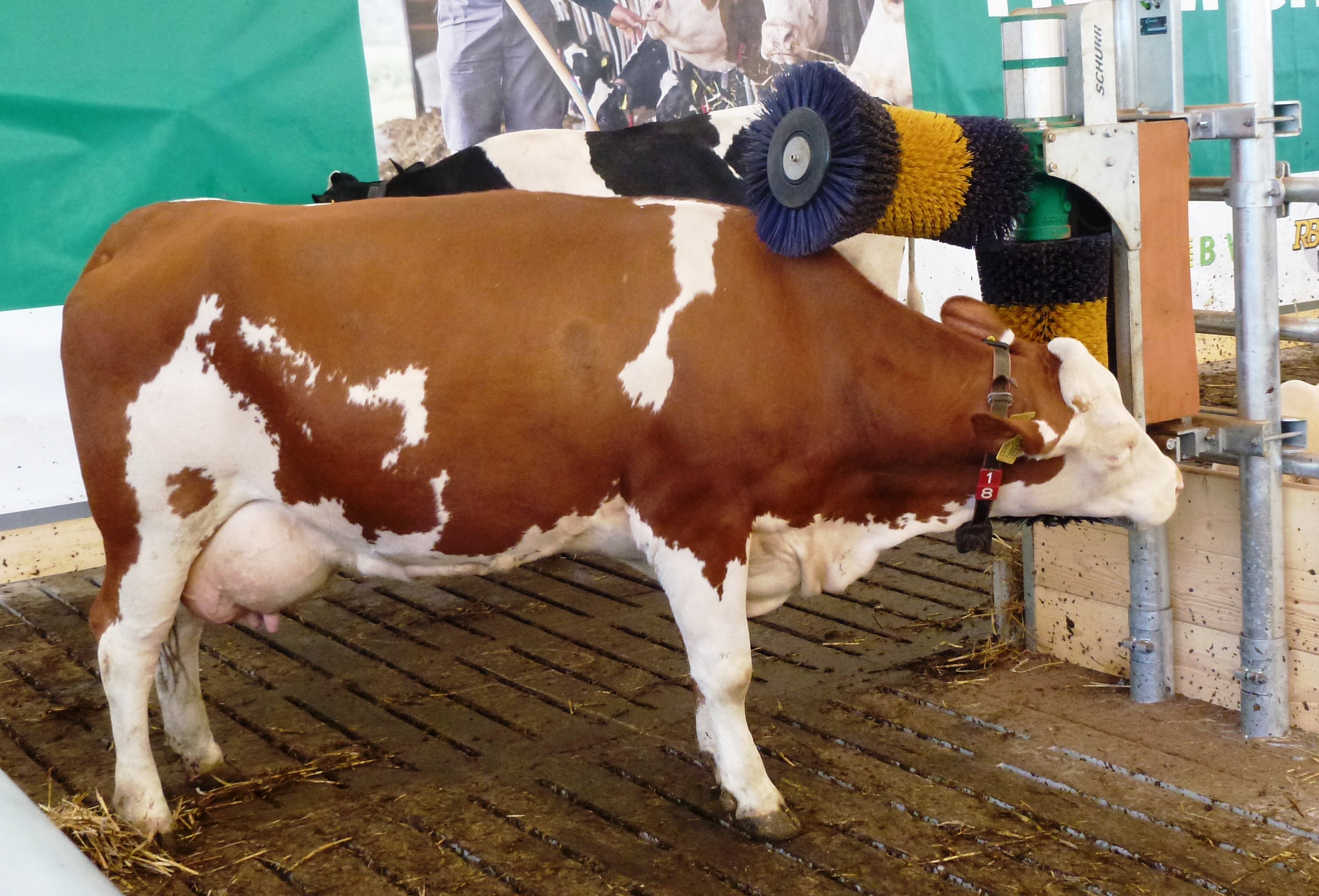
The built infrastructures of animal farming are “complex nodes of politics, practices, and human-animal relations.” 8 In this context, animal comfort on the industrial barn is indeed a form of design. It comprises architectural elements, fittings, and technologies that are specifically designed to create the artificial environment in which cows are destined to live. Many zootechnical elements counterbalance the industrial materiality of the barn, often in concrete, and they usually compensate for the lack of natural elements, like trees and grass. Nurture is embodied in rubber mats and waterbeds included in cow cubicles, for a comfortable reclined position. Nurture shapes plastic brushes that remove dirt and promote blood circulation, as well as the robots that have led to the automation of milking and cleaning routines.9 However doubtfully, nurture also defines the complex treatment boxes made of steel, that allow the operators to trim the hoofs and perform other veterinary practices.10 Nurture also spreads over the entire zootechnical landscape, which could be ideally designed to capture the excessive nitrogen emissions originating from dairy farming.11 Fig. 1-2

In 1903, British farm inspector and hygiene expert Edward F. Willoughby commented on the comfort of cows in relation to the material choices on the barn: “With the old rough cobble pitching on which the cows could not lie with comfort, a good supply of litter was necessary […]” and continued: “The partitions and mangers are commonly of wood, but cast-iron fittings are neater and cleaner, and present manifest advantages in the ease with which they may be disinfected in the event of any cow being affected with foot and mouth disease, or tuberculosis.” 14 In 1914, American engineer Karl J. T. Ekblaw mentioned a special “floor brick” made of ground cork and asphalt, available “on the market”, to counterbalance the coldness and roughness of concrete floors.15
Most animal husbandry manuals attest that the barn’s architectural design and materiality act as a layer of comfort that enhances the animal’s capability to transform feed into protein for human consumption. Fig. 3 The zootechnical building, paired with human labor, operates as an artificial mother that nurtures livestock to human ends, as claimed by a 1976 handbook on calf housing: “To rear a calf away from its dam and other cows is to deprive it of its ‘natural’ form of nutrition, protection, warmth, shelter and social environment. For these are substituted a bucket, a building and a stockman.”16

My open question would be not how to technically nurture the animals that nurture us (the global zootechnical industry seems to be providing excellent answers to this question) — but how should humans ethically nurture domesticated animals, beyond the strictly economic and anthropocentric ends of farming? What would animal comfort be, if animals were not exploited as commodities, raw materials, and labor force? 18 What would be the role of design if cows stepped beyond the patterns of reproduction, production, and consumption, and nurture took place in the Foucauldian heterotopias represented by animal sanctuaries?19
1. Mark Kurlansky, Milk: A 10.000-Year History (Bloomsbury, 2018) 3–4.
2. Andri Snær Magnason, On Time and Water (Serpent’s Tail, 2020).
3. Anne Mendelson, The Myth of Milk as Superfood (Columbia University Press, 2023); Kendra Smith-Howard, Pure and Modern Milk: An Environmental History since 1900 (Oxford University Press, 2014).
4. Food and Agriculture Organization of the United Nations, https://www.fao.org/economic/est/est-commodities/dairy/school-milk/15th-world-milk-day/en/, last accessed October 17, 2025.
5. The data covers the time span 1961–2022: https://ourworldindata.org/grapher/per-capita-milk-consumption?tab=line&time=earliest..2022, last accessed October 17, 2025.
6. Ruth Harrison, Animal Machines (Vincent Stuart Publishers, 1964).
7. Abigal Woods, “From Cruelty to Welfare: The Emergence of Farm Animal Welfare in Britain, 1964–71,” Endeavour 36, no. 1 (2012): 14–22 [21]. See also: Joy A. Mench, “Animal Welfare – Is Intensification The Problem?,” in The Routledge Handbook of Animal Ethics, edited by Bob Fischer (Routledge, 2020), 141–53.
8. Introduction to Animal Housing and Human-Animal Relations: Politics, Practices, and Infrastructures, edited by Kristian Bjørkdahl and Tone Druglitrø (Routledge, 2016).
9. Víctor Muñoz Sanz, “Genes, Robots, and Toxicity: The Haunted Landscapes of Milk Production,” Solitude Journal 1 (2020): 58-67.
10. This argument is at the core of “The Animal is Present”, a section co-curated by Víctor Muñoz Sanz and Sofia Nannini, in the forthcoming exhibition Convivium: Food Systems at the Limit, Architekturmuseum der TUM, Munich, April 23, 2026 to October 11, 2026, https://www.architekturmuseum.de/, last accessed October 20, 2025.
2. Andri Snær Magnason, On Time and Water (Serpent’s Tail, 2020).
3. Anne Mendelson, The Myth of Milk as Superfood (Columbia University Press, 2023); Kendra Smith-Howard, Pure and Modern Milk: An Environmental History since 1900 (Oxford University Press, 2014).
4. Food and Agriculture Organization of the United Nations, https://www.fao.org/economic/est/est-commodities/dairy/school-milk/15th-world-milk-day/en/, last accessed October 17, 2025.
5. The data covers the time span 1961–2022: https://ourworldindata.org/grapher/per-capita-milk-consumption?tab=line&time=earliest..2022, last accessed October 17, 2025.
6. Ruth Harrison, Animal Machines (Vincent Stuart Publishers, 1964).
7. Abigal Woods, “From Cruelty to Welfare: The Emergence of Farm Animal Welfare in Britain, 1964–71,” Endeavour 36, no. 1 (2012): 14–22 [21]. See also: Joy A. Mench, “Animal Welfare – Is Intensification The Problem?,” in The Routledge Handbook of Animal Ethics, edited by Bob Fischer (Routledge, 2020), 141–53.
8. Introduction to Animal Housing and Human-Animal Relations: Politics, Practices, and Infrastructures, edited by Kristian Bjørkdahl and Tone Druglitrø (Routledge, 2016).
9. Víctor Muñoz Sanz, “Genes, Robots, and Toxicity: The Haunted Landscapes of Milk Production,” Solitude Journal 1 (2020): 58-67.
10. This argument is at the core of “The Animal is Present”, a section co-curated by Víctor Muñoz Sanz and Sofia Nannini, in the forthcoming exhibition Convivium: Food Systems at the Limit, Architekturmuseum der TUM, Munich, April 23, 2026 to October 11, 2026, https://www.architekturmuseum.de/, last accessed October 20, 2025.
12. Miriam Borgia, “Defining Animal Well-Being: Sciences and Practices of Care in Italian Animal Husbandry,” Animal History Group seminar series, October 15, 2025, https://animalhistorygroup.org/seminar-series/, last accessed, October 20, 2025.
13. John Christian Curwen, Hints on Agricultural Subjects: And On the Best Means of Improving the Condition of the Labouring Classes (Johnson & Crosby, 1809), xxvi.
14. Edward F. Willoughby, Milk, Its Production and Uses: With Chapters on Dairy Farming, the Diseases of Cattle, and on the Hygiene and Control of Supplies (Griffin, 1903), 37.
15. Karl J. T. Ekblaw, Farm structures (Macmillan Co., 1914), 239.
16. Dan Mitchell, Calf Housing Handbook (Scottish Farm Buildings Investigation Unit, 1976), 4.
17. Benedetta Piazzesi, Così perfetti e utili: Genealogia dello sfruttamento animale (Mimesis, 2015), 167–73.
18. Dinesh Joseph Wadiwel, Animals and Capital (Edinburgh University Press, 2023).
19. Elena Bossini, and Fabio Bacchini, “Carne plant-based e spazi eterotopici,” Liberazioni: Rivista di critica antispecista 60 (Spring 2025): 38–45.
Sofia Nannini is an architectural historian who specializes in the relationship between building materials, society, and culture in nineteenth- and twentieth-century Europe. Since 2023, she has been an assistant professor in architectural history at the Politecnico di Torino. She is author of two monographs on the history of reinforced concrete in Icelandic architecture. She is currently working on a research project on the architectural history of intensive animal farming since the early modern era. This project has been supported by the Canadian Centre for Architecture and by the Paul Mellon Centre for Studies in British Art. Her proposal, Animal Farm: An Architectural History of Intensive Animal Farming (1570–1992), was recently awarded with an ERC Starting grant (2025).